
Why Clinical Communication & Collaboration
Clinical Communication and Collaboration for Large Health Systems
Large health systems depend on thousands of time-sensitive interactions every day. Nurses, physicians, care coordinators, transport teams, lab teams, pharmacy, case management, IT, and operational leaders all need to reach the right person quickly, securely, and with the right patient or workflow context.
When communication breaks down, the impact is not just frustrating; it can also delay care, increase cognitive burden, slow throughput, create redundant work, and introduce avoidable patient safety risk.
That is why many hospitals are moving beyond basic secure texting toward a more complete clinical communication and collaboration platform for health systems.
“

What Is Clinical Communication and Collaboration?
Clinical communication and collaboration for healthcare, often referred to as CC&C, is the technology category that helps hospital teams communicate securely, coordinate care, manage alerts, connect by role, and support real-time clinical workflows.
A strong CC&C platform typically includes:
- Secure HIPAA-compliant messaging
- Role-based communication
- Enterprise directory access
- Patient-centered communication channels
- Voice and messaging workflows
- Alerts and alarm routing
- EHR and clinical system integration
- Reporting and analytics
- Continuity and downtime support
For large health systems, CC&C is not simply a messaging tool, but a real-time workflow layer that helps teams act faster across complex care environments.
Why Large Health Systems Need More Than Secure Messaging
- Who is currently responsible for a patient
- Which role is covering a specific unit
- Whether a message is urgent or informational
- Whether the right person received and acted on the message
- How to escalate when there is no response Banyan Alerts & Alarms
- How communication should continue during downtime or system disruption

Mobile Heartbeat’s Banyan Platform
“The next generation of clinical communications and collaboration will require cloud computing, artificial intelligence, and healthcare data interoperability.”
Dr. David Rhew | Chief Medical Officer | Microsoft
Common Use Cases for Clinical Communication Platforms
Care teams need fast, secure ways to coordinate around patient needs. Patient-centered channels help nurses, physicians, specialists, and support teams communicate in one place instead of relying on fragmented calls, texts, and manual workarounds.
Nurses are often the center of hospital communication. A CC&C platform can reduce unnecessary interruptions, organize communication by patient or workflow, and help nurses quickly reach the right person.
Hospitals receive constant alerts from nurse call systems, telemetry, patient monitoring, labs, and other systems. A clinical communication platform can help route alerts to the right role or team, reduce noise, and support faster response.
The EHR is essential for documentation, but many real-time care decisions happen outside the EHR. A CC&C platform can complement the EHR by helping teams act in the moment while maintaining workflow context.
Many hospitals are still trying to eliminate pagers or reduce dependence on legacy communication tools. A modern platform can replace outdated paging workflows with secure, mobile, role-aware communication.
Large health systems need communication workflows that remain resilient during planned or unplanned downtime. Communication continuity is especially important when clinical operations cannot pause.
What to Look For in a Clinical Communication and Collaboration Platform
When evaluating a CC&C platform, large health systems should consider:
Enterprise Scalability: Can the platform support thousands of users across multiple hospitals, departments, roles, and workflows?
Interoperability: Can it integrate with the EHR, nurse call, clinical alerts, directories, scheduling systems, and other hospital technologies?
Role-Based Communication: Can staff reach the right person by role, unit, patient assignment, or coverage responsibility?
Workflow Flexibility: Can the platform support different communication patterns across nursing, physicians, ancillary teams, transport, pharmacy, and operations?
Security and Compliance: Does the platform support HIPAA-compliant communication, secure messaging, auditability, and enterprise governance?
Reliability and Continuity: Can it support mission-critical communication and help maintain operations during downtime?
Implementation Support: Does the vendor understand hospital workflows and provide hands-on support to help the organization design, deploy, and optimize communication processes?


Looking for more information on CC&C implementation?
See Mobile Heartbeats seven-phase process from vendor vetting through rollout and maintenance, how to assemble your mobility team, audit systems, perform complete discovery, building the technical environment, and overall managing the rollout.
How Banyan Supports Clinical Communication and Collaboration for Healthcare
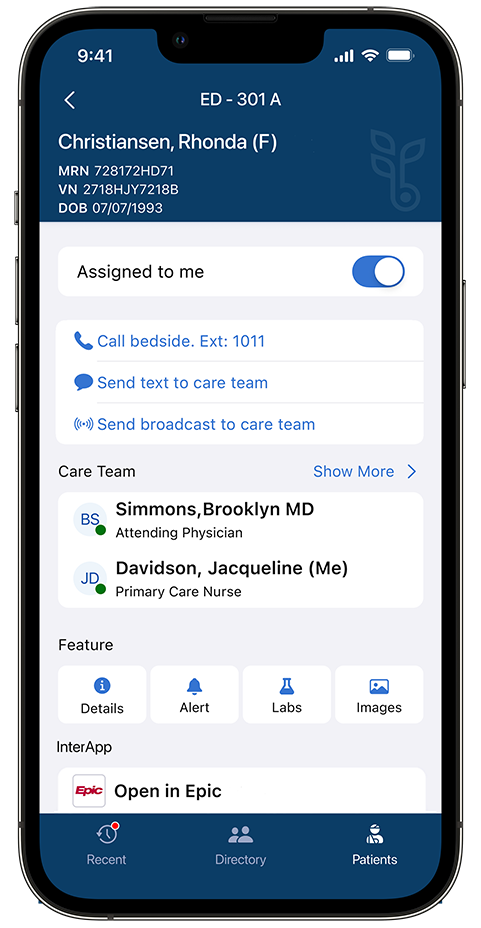
Mobile Heartbeat’s Banyan platform is designed to help large health systems improve real-time communication, care team coordination, and clinical workflow execution.
Banyan supports:
- Secure clinical messaging
- Voice communication
- Alerts and alarms
- Patient and care team communication
- Dynamic roles and enterprise directory workflows
- Microsoft Teams® integration
- EHR complement workflows
- OpenAPI-based integrations
- Enterprise management
- Continuity services
- Professional services implementation support
Banyan provides a flexible platform for communication workflows across the enterprise.
Related Topics
Improve Communication and Collaboration Enterprise Wide
Clinical communication is one of the most controllable levers large health systems have for improving efficiency, reducing delays, supporting care teams, and strengthening patient safety.
For enterprise hospitals, the goal is no longer just to send secure messages. The goal is to create a connected, resilient, interoperable communication layer that helps care teams act quickly and confidently.